


Latest News

Acknowledgment: Funded by the European Union (AI4HOPE, 101136769). Views and opinions expressed are however those of the author(s) only and do not necessarily reflect those of the European Union or the Health and Digital Executive Agency. Neither the European Union nor the granting authority can be held responsible for them.
This work was funded by UK Research and Innovation (UKRI) under the UK government’s Horizon Europe funding guarantee [Grant No. 101136769].
© 2025 by AI4HOPE Consortium




INTRAS
From What Matters to What Works: Co-Creating AI for Dementia Care
.jpg)
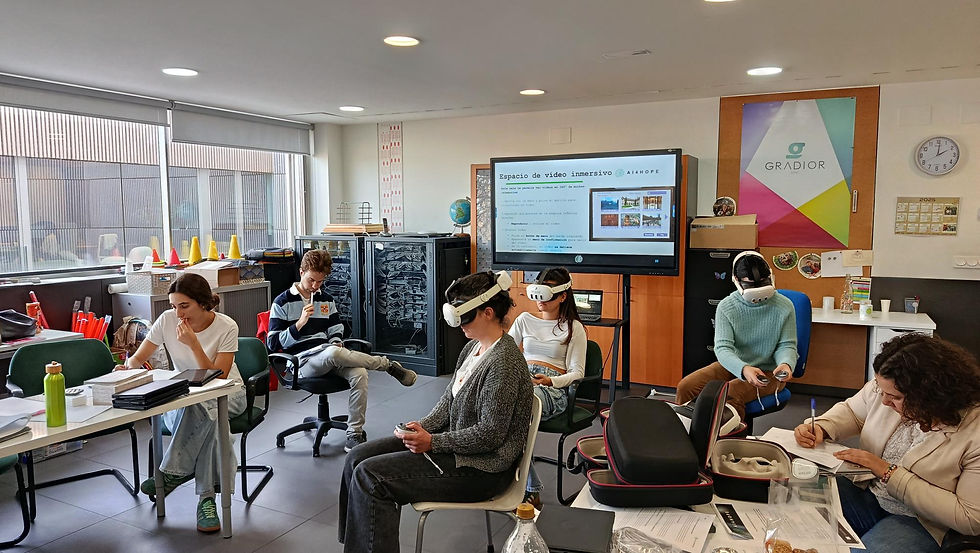
AI4HOPE aims to develop AI-supported tools that can contribute to the emotional wellbeing of people with dementia and support earlier, person-centred conversations and decisions about future care. From the beginning, this has meant more than developing technology: it has meant understanding what matters to people and how digital support might fit into their everyday lives and care. Across four co-creation sprints in Germany, Ireland, Slovenia, Spain, Portugal and the United Kingdom, people with dementia, family caregivers and healthcare professionals contributed alongside researchers and technical partners. Their involvement evolved with the project: from exploring lived experiences, needs and values, through engaging with increasingly tangible concepts and prototypes, to reflecting on how emerging solutions could meaningfully fit within everyday care. Each cycle built on previous learning, allowing both the technologies and the co-creation process itself to be progressively adapted to participants, contexts and evolving implementation realities.
At the heart of this process was a simple but essential principle: the people whose lives may be affected by these technologies must have a meaningful voice in shaping them: “Nothing about us without us.”
Meaningful participation, however, does not happen simply by bringing people into a room. Before the first sprint, AI4HOPE partners worked with Alzheimer Europe, drawing directly on the perspectives of people with dementia and caregivers, to develop shared co-creation guidelines. These helped local teams create supportive, accessible and adaptable conditions for participation, with flexibility to adjust language, pace, materials and ways of taking part according to participants’ needs and local contexts.
The early co-creation activities focused on understanding lived experiences, unmet needs and what people valued in their everyday lives and care. Through different participatory exercises, people with dementia, caregivers and professionals explored experiences, emotions, relationships and expectations for future support. This helped identify not only where difficulties existed, but also what people wanted to preserve, including autonomy, identity, reassurance and meaningful relationships. These insights helped guide the concepts and requirements explored as the project moved forward. As concepts and prototypes became increasingly tangible in subsequent sprints, the focus also evolved. Participants could engage more concretely with the emerging solutions, identifying issues around accessibility, confidence, privacy, emotional appropriateness and the human support that may be needed around technology use. This helped move co-creation from exploring what people might need towards understanding how emerging solutions could work meaningfully in everyday life.
By the final sprint, the focus had expanded beyond refining the technology itself. Healthcare professionals reflected on how digital solutions could realistically fit within dementia care, bringing questions of dignity, autonomy, communication, relationships and care realities into considerations about future use. This highlighted that meaningful innovation depends not only on the characteristics of a tool, but also on the people, relationships and care environments surrounding its use.
Across these different stages, values remained a connecting thread. Dignity, autonomy, trust, identity, emotional wellbeing and meaningful human relationships repeatedly shaped how emerging solutions were considered. Technology was seen as valuable when it could support what matters to people, such as autonomy, communication, decision-making or reassurance, without adding unnecessary burden or replacing the human relationships at the heart of care. The four co-creation sprints show the value of co-creation as an evolving process rather than a single step in technological development. By bringing together lived experience, professional knowledge, research, and technical expertise over time, AI4HOPE has been able to progressively explore not only what the technologies should do, but also what may be needed for them to be meaningful and appropriate within real dementia care. Ultimately, meaningful co-creation is not about asking people what they think of a technology. It is about allowing their experiences, values and changing realities to shape the journey, so that innovation evolves not only towards what technology can do, but towards what truly matters in people’s lives and care.
